
Sailboat Survey Guide – Chapter 1: GRP (Fiberglass) Hull Structure and Fundamental Defects
Fiberglass, technically known as GRP (Glass Reinforced Plastic), has been the most common material in serial boat construction since the 1950s. While the quality of materials like wood or steel is predetermined, the quality of GRP is determined on the day the boat is molded.
The final quality of GRP depends directly on the skill and mood of the laminator that day, as well as the resin-to-glass ratio used. In this article, we will examine sailboat hull structures, potential defects based on production methods, and what you, as a buyer or surveyor, need to watch out for.
1. Solid (Single Skin) GRP Hull Structure
In older generation boats (e.g., 1970s and 80s British classics like Westerly or Nicholson), the hull structure was generally built with the logic that “thicker is stronger.” These boats are heavy, and the hull thickness is substantial enough that they require very little additional reinforcement.
Common Defects and Detection Methods:
- Delamination: GRP consists of layers of glass fiber bonded together with resin. If the layers do not bond well during production or if the boat suffers a hard impact, these layers can separate from each other.
- Resin Starvation (Dry Areas): These are areas where the glass fiber was not sufficiently wetted with resin. These spots cause structural weakness and lead to delamination over time.
- Detection Method (Hammer Sounding): The most effective way to detect these defects is to lightly tap the hull from the outside with a small hammer. A sound laminate gives a sharp, hard ring, while delaminated or dry areas produce a “dull,” “hollow,” or “dead” sound.
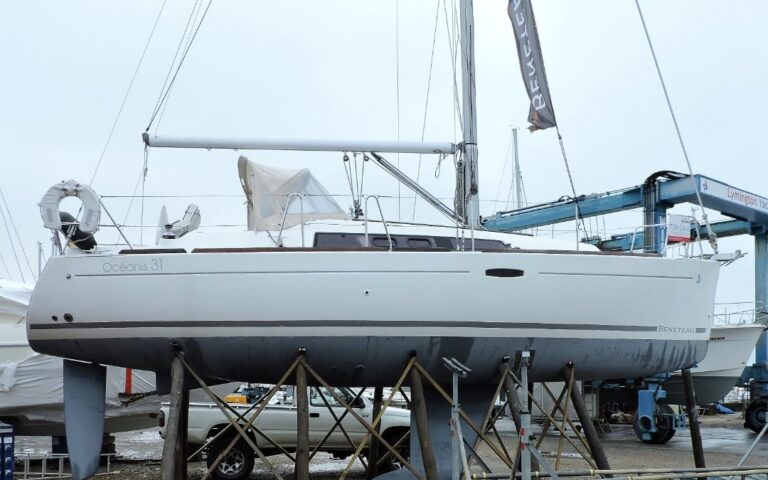
Important Note: Percussion testing (hammer sounding) must be done while the boat is on the hard (out of the water). Doing this on a floating boat yields misleading results as the water dampens the sound.
2. Modern Boats with Inner Mouldings (Liners)
Most modern production sailboats (Beneteau, Jeanneau, Bavaria, etc.) use “inner moulding” or “pan” systems to reduce costs and create a clean interior finish. In this system, the boat’s structural grid (stringers and floors) and furniture bases are produced in a separate mold and later glued into the main hull.
Survey Challenges and Risks:
- Inaccessible Areas: The biggest disadvantage of this structure is that the internal hull surface cannot be seen during a survey. Many professional surveyors note these areas as “inaccessible” in their reports and do not accept liability for structural bonds.
- Hidden Structural Damage: Structural integrity relies on the putty or resin bond where the liner meets the hull. If the boat runs aground, this bond can shear, but the damage might not be visible from the outside or inside.
- Cracks: Deep keels on modern boats exert a large leverage force on the hull during a grounding. In such cases, gelcoat cracks in the liner (especially around the mast step and keel studs) can be harbingers of deep structural fractures.
2025 Update & Tech Note: Today, many manufacturers have switched to Vacuum Infusion to overcome bonding issues. This method draws resin into the fiber via vacuum, minimizing human error and optimizing the resin-fiber ratio. However, the second-hand market still contains thousands of boats produced via the hand lay-up method.
3. Sandwich Construction
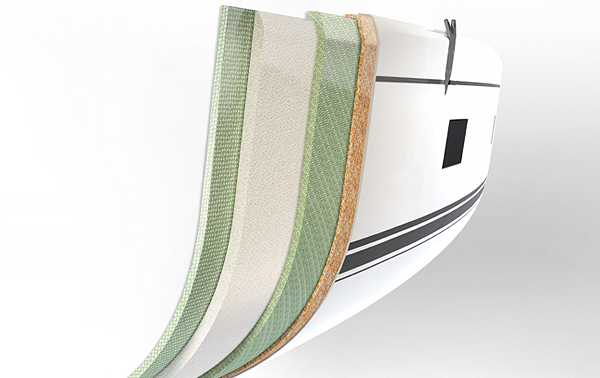
In performance boats and modern designs, Balsa wood or PVC foam is placed between two GRP skins to provide stiffness and reduce weight. This is called sandwich construction.
Critical Risk: Core Rot
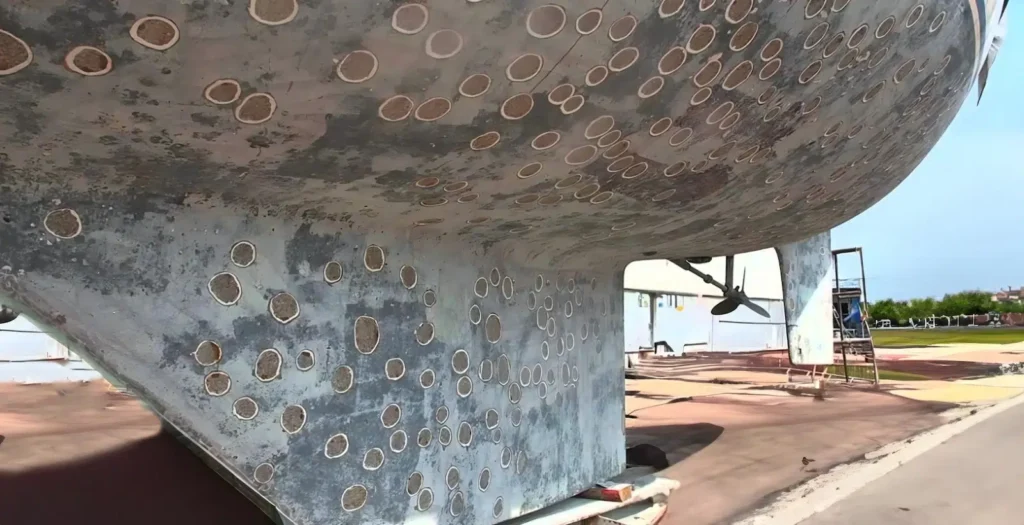
- If a hole is drilled in the hull (e.g., for a skin fitting) and not properly sealed, water will eventually seep into the core material.
- Material Difference: If the core is Balsa, it absorbs water like a sponge and rots. Closed-cell foam does not absorb water but can suffer from debonding due to hydraulic pressure.
- Detection: When tapped with a hammer, a solid sandwich structure gives a solid sound. However, if the core is wet or rotten, the sound becomes dull. Moisture meters are also vital for detecting water accumulation in sandwich structures.
4. Gelcoat Cracks and “Hard Spots”
Fine hairline cracks (crazing) seen on the hull can be merely cosmetic, or they can signal a structural issue.
- Hinge Effect: The hull flexes at points where a flexible area meets a very rigid support (e.g., where a bulkhead is bonded to the hull). This flexing over time causes fatigue in the laminate and cracks in the gelcoat.
- Recommendation: When you see a crack, scraping back the gelcoat (if permissible) can reveal whether the crack is superficial or extends deep into the laminate.
5. The Surveyor’s Golden Rule: Fact vs. Opinion
Paul Stevens emphasizes that the most important rule in reporting is maintaining the distinction between Fact and Opinion.
- Example: “Stainless steel U-bolts are used for the chainplates” is a Fact. “The U-bolts appear to be in good condition” is an Opinion.
- A good survey is the art of bringing opinion closer to fact through simple tests (e.g., using a lever to check for movement in the U-bolts).
📖 Chapter 1 Glossary: Terms and Meanings
- GRP (Glass Reinforced Plastic): A composite material made of a plastic matrix reinforced by fine fibers of glass.
- Lamination: The process of building up the hull thickness by bonding layers of fiber and resin.
- Gelcoat: The outermost resin layer that protects the GRP, provides color, and gives a smooth finish. It is the boat’s skin, not just paint.
- Delamination: The separation of the layers of fiberglass and resin. A serious structural defect.
- Inner Moulding (Liner): A structural grid and interior unit produced separately and bonded to the hull.
- Stringer: Longitudinal structural members that stiffen the hull (running bow to stern).
- Bulkhead: Vertical walls within the hull that separate compartments and provide transverse strength.
- Sandwich Construction: A construction technique using a lightweight core (foam/balsa) between two skins of GRP.
- Hard Spot: A localized area of high stiffness in a flexible panel, often leading to stress cracking (e.g., where a bulkhead meets the hull).
Next Chapter: Moisture Issues: Osmosis and Wicking