Sailboat Survey Guide – Chapter 4: Keel Types and Critical Connection Checks
On a sailboat, the keel is not just a center of gravity and a balancing element; it is the component that challenges the vessel’s structural integrity the most. The transition from the long, integral keels of older boats to the deep, thin fin or bulb keels of modern vessels has radically shifted structural stress points.
In this chapter, we will examine the two main keel types (Encapsulated and Bolted-on) and how to detect their potential nightmare scenarios.
1. Risks Introduced by Modern Design
In older boats, keels typically had a long and wide base (“long keel”), which distributed the load over a very large area of the hull. However, modern boats commonly feature deep, short, and narrow-based keels (“fin keel”) for performance and maneuverability.
Critical Engineering Risk: The Leverage Effect
- When a boat runs aground at speed (hard grounding), the lowest tip of the keel acts like a massive lever arm.
- This impact pulls the hull downwards at the front of the keel (leading edge) while pushing the hull upwards at the back (trailing edge).
- The hull section behind the keel on modern boats is often flat (flat section), and this shape is not as resistant to flexing as the older V-shaped forms. Therefore, stress cracks (stress crazing) in the hull structure and internal grid behind the keel are common in modern boats that have suffered a hard grounding.
2. Encapsulated Keels
In this design, the keel is an integral part of the hull mold. Externally, there is no joint or bolts between the hull and the keel. The ballast (weight) is poured into this fiberglass cavity and sealed over with resin/fiberglass.
The Hidden Danger: Corroding Internal Ballast
- Material: For cost reasons, iron or scrap steel (steel punchings) is often used. More expensive, high-quality boats prefer lead.
- The Problem: If the bottom of the keel is damaged due to grounding or abrasion (penetrating the fiberglass), water gets in. If the internal ballast is iron, it rusts and expands (iron oxide occupies more volume than the metal itself).
- The Result: The expanding rust creates immense hydraulic pressure inside, cracking the fiberglass shell of the keel from the inside out (laminate splitting).
- Detection: If you see vertical cracks on the side of the keel or rusty water trickling out (weeping) from the bottom while the boat is on the hard, you can deduce that the internal ballast is exposed to water and is “growing” inside.
- Tip: You can check whether the ballast is iron or lead using a magnet test (lead is non-magnetic). Lead ballast does not rust or swell.
3. Bolted-on Keels and “Keel Studs”
In most mass-production boats, cast iron or lead keels are mounted to the hull using stainless steel studs. Although often referred to as “keel bolts” in reports, these are usually studs fixed into the keel during the casting process and are very difficult (sometimes impossible) to replace.
A. “The Smile”
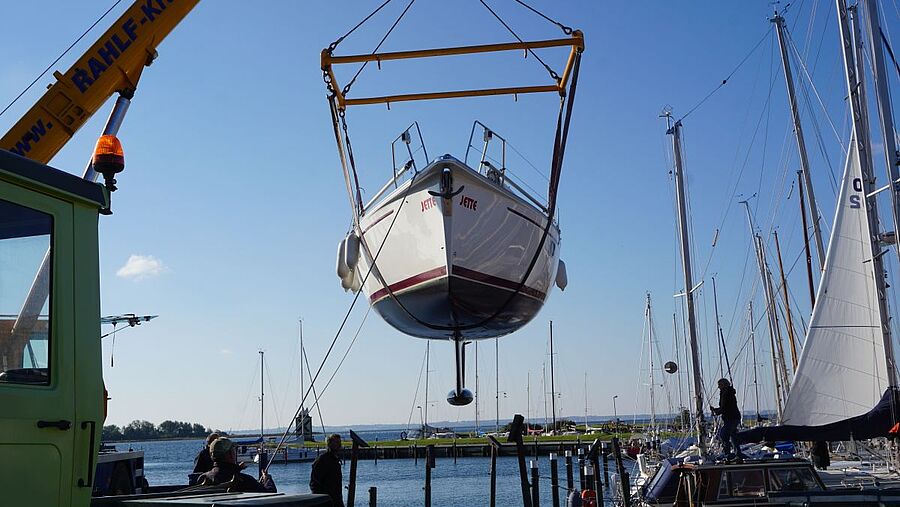
For professional surveyors, the moment the boat is suspended in the travel lift slings is golden.
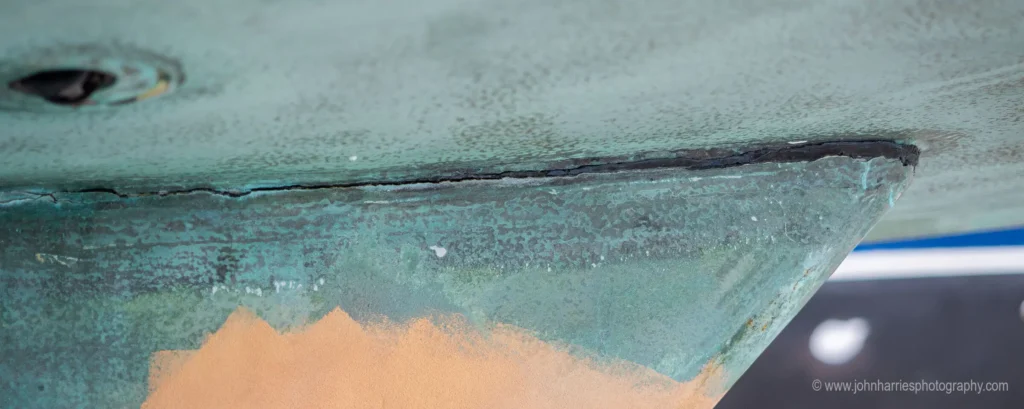
- What is it? Known in industry jargon as the “Keel Smile,” this is a curved gap that opens up at the front (leading edge) of the keel-to-hull joint when the boat is hanging, and the keel pulls down under its own weight.
- Significance: A gap that opens in the slings but closes when the boat rests on its keel is evidence that the bolts are loose/broken or the hull structure is flexing dangerously.
- Rust Trails: Brown rust stains (rust weeping) trickling down from the joint are the clearest external sign that the bolts are wet and corroding.
B. Corrosion and “Crevice Corrosion”
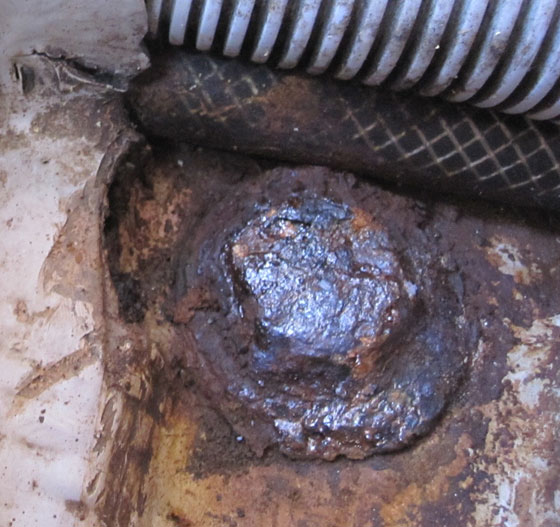
Internal keel studs and nuts often sit in the deepest part of the bilge where water accumulates. Stainless steel suffers from corrosion in anaerobic environments (e.g., between wet nut threads or under sealant where there is no oxygen). This is called “Crevice Corrosion.” A bolt or nut may look shiny on the outside but be rotten at the root of the threads.
- Test: Suspicious, rusty nuts should be hammer-tested by an expert. Sometimes a nut that looks solid externally can shatter under a hammer blow.
4. Keel Root and Internal Structural Supports (Matrix/Grid)
Modern boats use internal frame systems called an “Internal Matrix” or “Floor Pan” to distribute the keel load. This skeleton spreads the massive loads from the keel throughout the hull.
Critical Check:
- Are there cracks in this internal structure around the keel nuts?
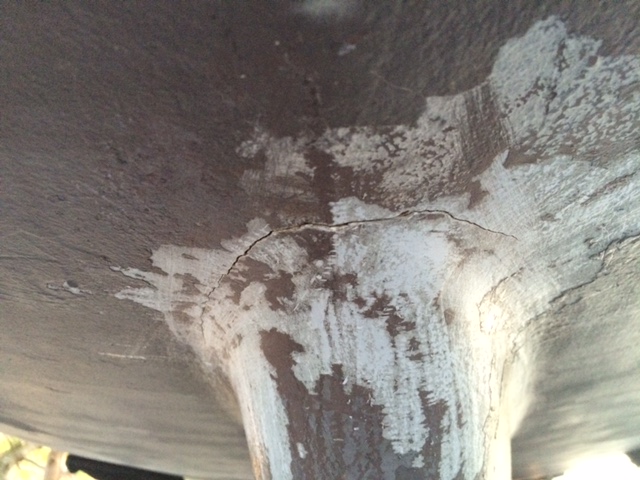
- Gelcoat cracks seen specifically on the “floors” (transverse structural members) at the front and back of the keel are rarely just cosmetic; they usually indicate that the underlying fiberglass structure has been subjected to excessive stress.
Current Note (Bonded Grids): In new-generation boats, these internal structures are bonded to the hull with very strong adhesives (methacrylate adhesives). However, a hard grounding can fracture this bond. A boat that looks undamaged on the outside may be suffering from de-bonding (separation of the hull and grid) on the inside. This means the boat has lost its structural rigidity, and repairs are extremely costly.
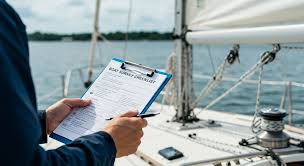
Summary Checklist (For Buyers)
- Check in Slings: Look at the keel-to-hull joint while the boat is being lifted. Is there a “Smile” (gap)?
- Rust Trails: Are there trails of rusty water weeping down from the keel joint? (A sign of corroding bolts).
- Internal Inspection: Open the bilge. What is the condition of the keel nuts and backing plates? Are they excessively rusty? Do the nuts look original or retro-fitted?
- Crack Check: Are there stress cracks in the fiberglass structure (especially on transverse floors) around the keel nuts?
📖 Chapter 4 Glossary: Terms and Meanings
- Encapsulated Keel: A structure where the ballast is poured into a fiberglass cavity integral to the hull. No bolts are involved.
- Bolted-on Keel: A structure where a cast (iron or lead) keel is mounted to the hull via studs.
- Keel Studs: Stainless steel rods usually fixed into the keel during casting, threaded at the top.
- The Smile: Industry jargon for the curved gap that opens at the front of the keel-hull joint when the boat is lifted or grounded.
- Crevice Corrosion: A treacherous type of corrosion that attacks stainless steel in oxygen-starved, wet environments (threads, under washers, etc.).
- Internal Matrix / Grid: A cage-like structure bonded inside the hull of modern boats to distribute the keel loads.
Next Chapter: Rudder Systems and Corrosion Risks