Sailboat Survey Guide – Chapter 2: Moisture Related Issues (Osmosis and Wicking)
The most commonly heard, yet often misunderstood, term when buying a used sailboat is “Osmosis.” For many buyers, osmosis implies that the boat has “cancer,” the hull is dissolving, and one should run away immediately. However, from a professional surveyor’s perspective, the situation is much more nuanced.
A fundamental fact accepted in the marine industry is this: Every GRP (fiberglass) boat sitting in water absorbs moisture. This is an inevitable law of physics. The task of a surveyor or an informed buyer is to determine whether the boat is simply “damp” or if this moisture has turned into a structural “defect.”
1. Fundamental Concepts: Moisture vs. Defect
It is essential to distinguish between two concepts often confused in survey reports:
- High Moisture Content: This is the state where the hull has absorbed water. On its own, this is not a defect; it is expected, especially in older boats that remain in the water year-round.
- Moisture Related Defects: This refers to physical deterioration (blistering, fiber separation, hydrolysis) of the material resulting from moisture absorption. This is the real cause for concern and a point for negotiation.
2. Common Moisture Problems
During a survey of the underwater hull, there are three main conditions you may encounter:
A. Aeration of the Gelcoat
This condition is often confused with osmosis but is actually a manufacturing defect.
- What is it? Tiny air bubbles trapped in the gelcoat (the outermost resin layer) during the application process in the mold. They exist even before the boat ever touches the water.
- Appearance: Usually 2-4 mm in diameter, pinhead-sized, hard, round voids that look like a dense rash. Unlike osmosis blisters, these voids are not deep in the laminate but only within the surface gelcoat layer.
- Significance: Generally does not pose a structural threat. It is largely cosmetic.
B. Wicking
- What is it? Water molecules passing through microscopic pores in the gelcoat and traveling along the glass fiber strands via capillary action.
- Appearance: Difficult to see with the naked eye. Under a magnifying glass (preferably 10x), it looks like fine “white stars” or “worm tracks” beneath the gelcoat. Unlike the round shape of aeration, wicking is linear as it follows the fiber.
- Test: If you press a sharp point into a suspected area and hear a slight “crunching” sound, the fibers have begun to separate from the resin. This is often a precursor to osmosis.
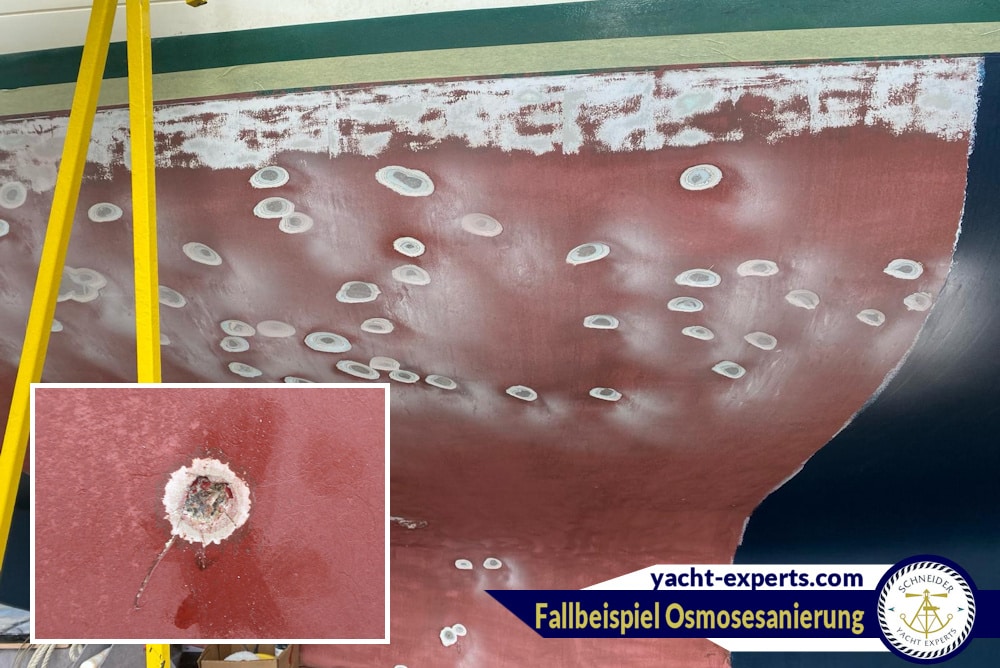
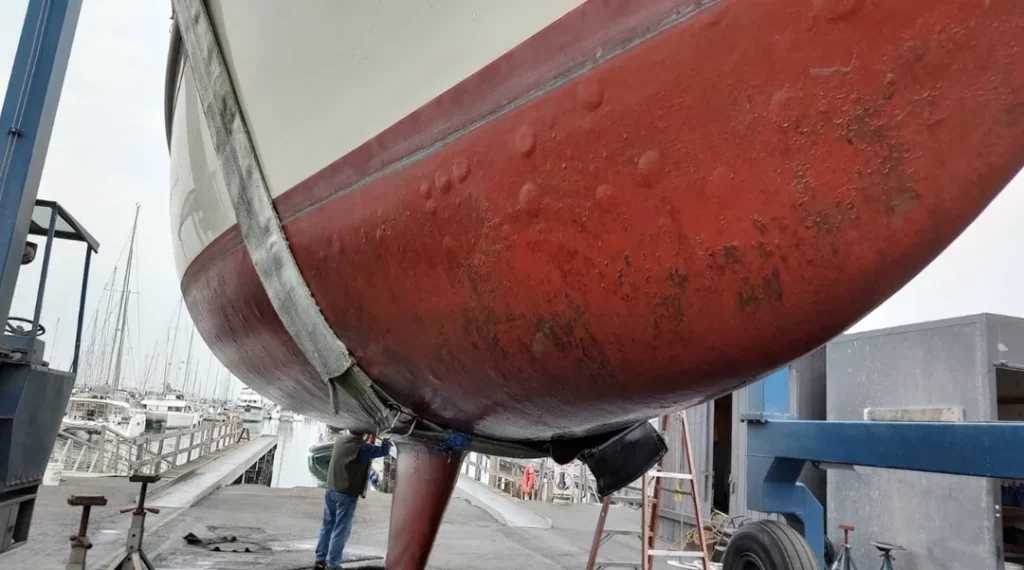
C. Osmotic Blistering
The boat owner’s nightmare. Its scientific name is Hydrolysis. Water molecules pass through the gelcoat, react with uncured chemicals within the laminate, and form an acidic liquid. This liquid expands, creating pressure that pushes the gelcoat outward, forming a blister.
- Detection: If a blister is popped and the liquid released has a sharp vinegar-like smell (acetic acid), is yellowish, and sticky, it is a genuine osmotic blister.
- The Trap: Sometimes blisters form between layers of paint and can be mistaken for osmosis. Scraping is necessary to determine whether the blister is under the gelcoat or just between the antifouling layers.
3. Detection Methods: The Surveyor’s Toolkit
Three main methods are used to detect invisible problems:
1. Visual Inspection (Grazing Light): The best way to see osmosis blisters is during the evening when the sun is low and shadows are long. A grazing light (holding a flashlight parallel to the hull) is used to highlight the slightest ripples and shadows on the surface.
2. Scraping: A small section of antifouling (e.g., 70mm x 70mm) is removed with a sharp scraper.
- If the gelcoat surface has micro-blisters, the scraper will “shave” the tops off these mounds, revealing white dots on the gelcoat.
- This is the most effective way to catch early-stage osmosis that has not yet formed visible blisters.
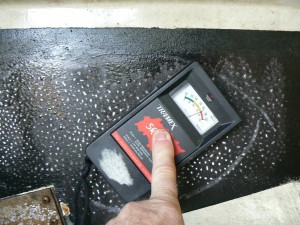
3. Moisture Meters: These devices are standard tools for surveyors but can be highly misleading if not used correctly.
- How it Works: The device sends radio waves into the material and measures conductivity. Water is a good conductor.
- Important Warning: Moisture meters do not give a clear “percentage” like wood moisture meters; they provide a relative value.
- False Positives:
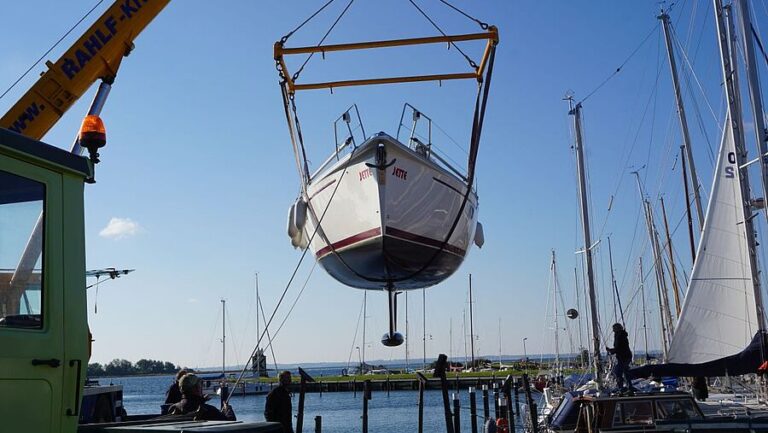
- If the boat has just been hauled out (it should be on the hard for at least 2 weeks in summer, 4 weeks in winter), surface moisture will give misleadingly high readings.
- Bilge water accumulating inside or metal water tanks directly against the hull will cause the device to alarm “High Moisture.” Always check what is on the other side of the hull.
Sovereign Quantum Scale (Example Reference):
- 0-15 (Dry): Excellent condition.
- 16-20 (Low): No concern.
- 21-30 (Medium): Risk begins, should be monitored.
- 31-45 (High): High risk of defect formation, even if not yet visible.
- 46-100 (Wet): Usually accompanied by physical blistering.
2025 Perspective and Current Notes
Since the early 1990s, the increasing use of Isophthalic resins has significantly improved osmosis resistance. By 2025, this has advanced even further:
1. The Vinylester and Epoxy Revolution: Since the mid-2000s, the use of Vinylester resin has become standard in the outer skin layers of quality production boats and modern brands. Vinylester and Epoxy are far more impermeable to water molecules than older Polyester resins. Therefore, classic osmosis problems are much rarer in post-2010 boats (unless there is a manufacturing defect).
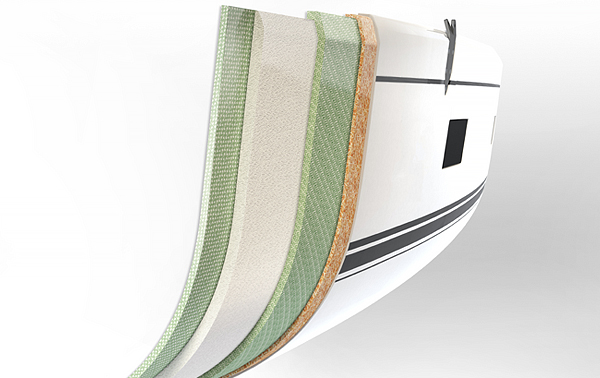
2. The Surveyor’s New Role: Wet Core: While classic osmosis risk has decreased in modern boats, “sandwich hull” construction has become widespread. In these boats, the moisture meter is vital not just for osmosis, but for detecting core saturation (water in the foam or balsa core). In a modern boat, a “wet core” is a much more costly, difficult, and dangerous problem than simple osmosis.
Conclusion: If you are buying an older boat (pre-1995), high moisture readings and slight osmosis blisters are bargaining points but not necessarily “deal-breakers.” If the boat is structurally sound, osmosis treatment (gelcoat peeling and epoxy coating) is a manageable process. However, if you see high moisture readings on a modern post-2010 boat, this points to a serious manufacturing defect or damage repair and should be approached with extreme caution.
📖 Chapter 2 Glossary: Terms and Meanings
- Osmosis: The process where water molecules penetrate the gelcoat, react with chemicals in the resin, and create pressurized blisters.
- Hydrolysis: The chemical breakdown of resin due to reaction with water. The scientific name for the osmosis process in boats.
- Wicking: Water traveling along glass fiber strands (like a wick in an oil lamp).
- Aeration: Air voids trapped in the gelcoat during manufacturing. A cosmetic issue.
- Vinylester Resin: A type of resin with much higher water resistance than polyester, used as a barrier against osmosis in modern boats.
- False Positive: An error where the moisture meter reads high due to surface wetness or metal backing, rather than structural moisture.
- Epoxy Barrier Coat: A waterproof primer layer applied to the hull after osmosis treatment or for protection (e.g., Gelshield).
Next Chapter: Critical Underwater Infrastructure: Keel and Rudder